Context
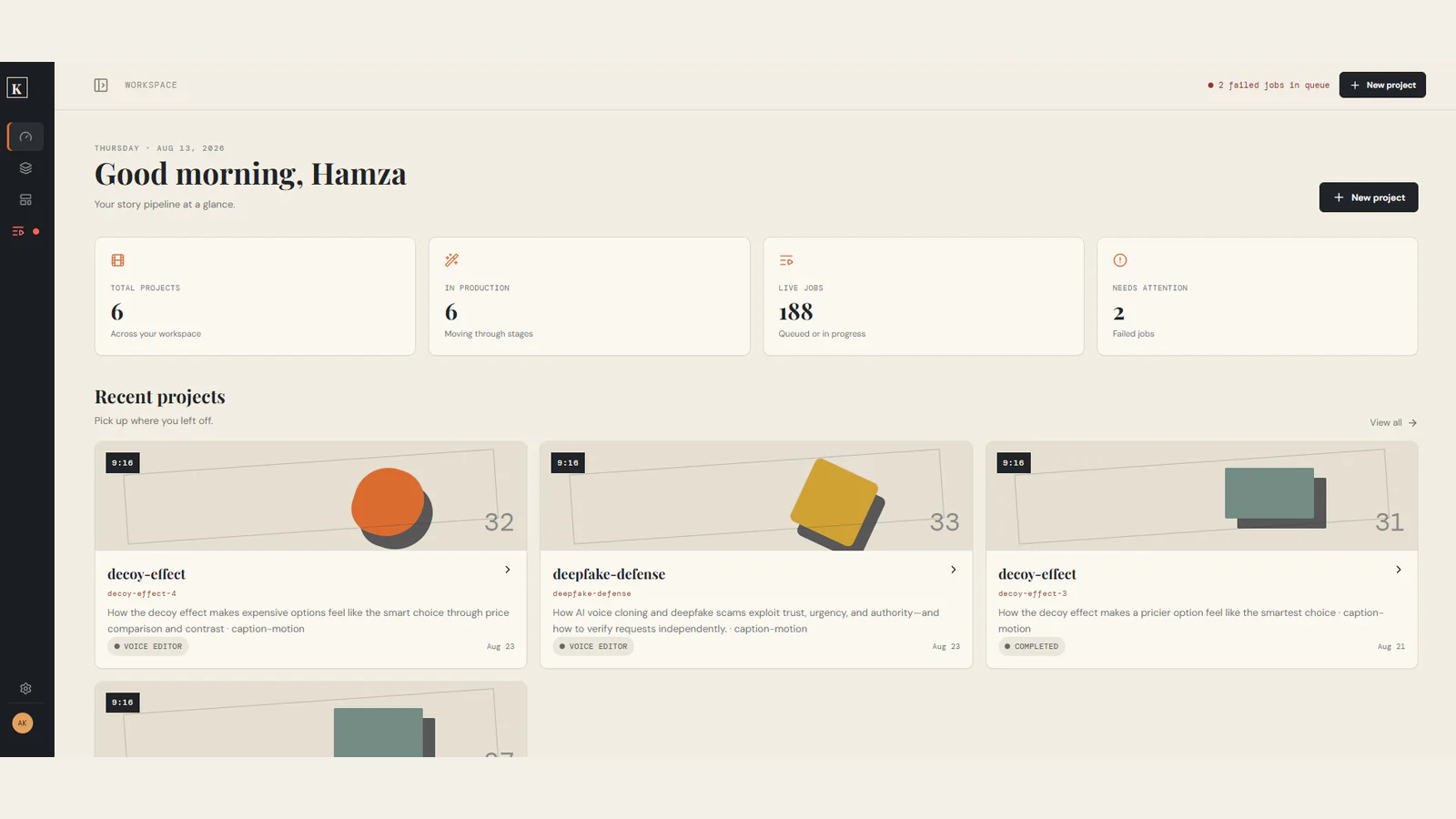
Video production involves a chain of dependent tasks. A script informs the imagery and narration; those assets need timing, captions, assembly, and a final render. Kovo brings those stages into a connected local-first workflow.
Engineering contribution
The work covered pipeline architecture, template controls, queues, validation, render monitoring, and retry paths. The workflow connects language-model scripting with imagery, narration, transcription, captions, and video assembly using Remotion and FFmpeg.
How the workflow is structured
- Brief and direction: define the story and template before generation starts.
- Generate the assets: connect scripting, imagery, and voice stages.
- Assemble and render: bring captions, timing, and composition together.
- Review and recover: validate outputs, inspect render status, and retry interrupted stages.
Engineering focus
The work extends beyond generating media. A connected workflow needs clear state between stages, controls over templates, and ways to understand what happened when a step fails.
Queues, monitoring, and recovery paths make the production flow easier to operate. Human review remains a deliberate part of the process.
What this demonstrates
Kovo shows the approach to practical AI implementation: connect model capabilities to a complete workflow, then build the controls needed around it.